To describe 2015 as an interesting year in the quest for a nuclear weapon-free world would be an understatement.
In May, states parties to the Treaty on the Non-Proliferation of Nuclear Weapons (NPT) failed to reach agreement
on the next steps needed to rid the world of nuclear weapons. In July,
Iran and the five permanent members of the United Nations Security
Council plus Germany (the P5+1) brokered a Joint Comprehensive Plan of
Action (JCPOA) concerning Iran’s nuclear programme. In August, the world
commemorated the 70th anniversary of the first use of nuclear weapons.
Under the provisions of the NPT, which was extended indefinitely 20
years ago, the five nuclear-weapon states – namely the United States of
America (USA), Russia, China, France, and the United Kingdom (UK) –
committed themselves to ‘pursue negotiations in good faith on effective
measures relating to cessation of the nuclear arms race at an early date
and to nuclear disarmament…’ The remaining 185 states parties – the
non-nuclear-weapon states – agreed to refrain from developing nuclear
weapons in exchange for the acknowledgment of their ‘inalienable right’
to research, develop and use nuclear energy for peaceful purposes.
Showing posts with label NPT. Show all posts
Friday, August 21, 2015
Tuesday, May 26, 2015
Time for a new roadmap to nuclear disarmament?
Seventy years after the destruction of Hiroshima and Nagasaki, the
world is no closer to an unequivocal commitment to abolishing nuclear
weapons.
The recent (27 April – 22 May) review conference of the Treaty on the Non-Proliferation of Nuclear Weapons (NPT) failed to reach consensus on how a world free of nuclear weapons could be achieved, and concluded without a final document. This raises the question whether it is time for a new framework.
Friday, November 29, 2013
29 November: Navigating nuclear traffic
Amelia Broodryk, Senior Researcher, Transnational Threats and International Crime Division, ISS Pretoria
The seizure of a kilogram of uranium and 90 ecstasy tablets in Durban, South Africa on 14 November presents an intriguing illicit trafficking case. A joint operation between the Durban Organised Crime Unit, Crime Intelligence, the Department of Minerals and the Department of Energy resulted in the arrest of two men in their early 20s, who now face charges of being in possession of drugs and uranium. Incidents of uranium smuggling are very rare, and this is one of only five confirmed seizures of smuggled uranium in South Africa in the past 20 years.
Thursday, April 25, 2013
24 April: Joint Statement delivered by Ambassador Minty, Permanent Representative of South Africa to the United Nations in Geneva on: “The humanitarian impact of nuclear weapons”
![]() |
| Source: IAEA |
2013 NPT Preparatory Committee
The Second Preparatory Committee for the 2015 Review Conference of the Parties to the Treaty on the Non-Proliferation of Nuclear Weapons (NPT) is on now from 22 April–3 May 2013 in Geneva, Switzerland. The chair of the meeting is Ambassador Cornel Feruta of Romania.
Calendar of events
NPT News in Review - subscribe now!
Statements
Documents
National reports
Information for civil society
Also see the official UN website.
Calendar of events
NPT News in Review - subscribe now!
Statements
Documents
National reports
Information for civil society
Also see the official UN website.
Thursday, May 24, 2012
Nuclear Weapons and their Consequences: The Relevance of International Humanitarian Law
Noel Stott, Senior Research Fellow, Transnational Threats and International Crime
According to the African Union (AU), the proliferation of weapons of mass destruction and their delivery systems remains one of the greatest threats to international peace and security. This was reaffirmed during the recent preparatory committee (PrepCom) meeting for the 2015 Review Conference of the Parties to the Treaty on the Non-Proliferation of Nuclear Weapons (NPT), held from 30 April to 11 May 2012 in Vienna. At the meeting the AU also reaffirmed Africa’s continued commitment to realising the goals and objectives of the NPT; to a world without nuclear weapons in which nuclear science and technology is [only] harnessed for the development of humankind.
Monday, May 7, 2012
NPT PrepCom 2012: First week recap
![]() |
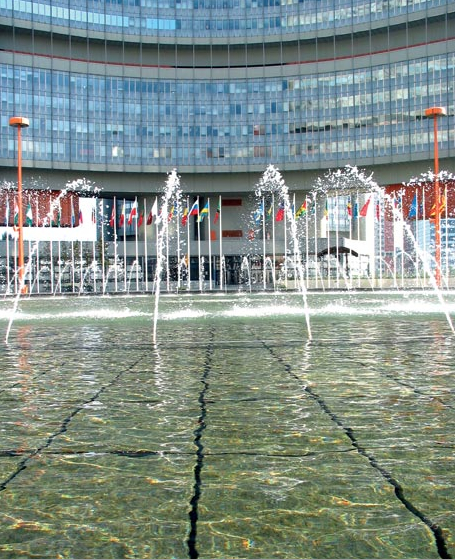
| Source: http://www.unvienna.org/unov/en/vic.html |
Once again, African states are making a positive contribution through statements and active participation during debates. The following African countries made statements during the general debate:
- Egypt, Mr. Ahmed Fathalla, First Under-Secretary Ministry of Foreign Affairs
- Morocco, Mr. Ali El Mhamdi, Permanent Representative to the UN Vienna
- Burkina Faso, Mr. Paul Robert Tiendrebeogo, Permanent Representative to the UN Vienna
- South Africa, Mr. Xolisa Mabhongo, Permanent Representative to the UN Geneva
- Algeria, Ms. Taous Feroukhi, Permanent Representative to the UN Vienna
- Namibia
- Nigeria
- Libya, Mr. Mohamed S.N. Shelli, Deputy Director, Department of the International Organizations
- New Agenda Coalition, Mr. Abdul S. Minty of South Africa
- Non-Aligned Movement, Mr. Ahmed Fathalla, First Under-Secretary Ministry of Foriegn Affairs of Egypt
- African Union, Mr. Tarek A. Sharif, Head, Defense and Security, Department of Peace and Security
- Non-Aligned Movement
- New Agenda Coalition, Ambassador Xolisa Mabhongo
- South Africa, Ambassador Xolisa Mabhongo, Permanent Representative to the IAEA
- Sudan
- Egypt, Mr. Sameh AboulEnein, Deputy Assistant Minister for Disarmament Affairs
- Algeria
NGOs were also provided with a platform to address the delegations and several organisations, including the New Agenda Coalition NGOs (which includes ISS) made statements at this year's PrepCom.
For more information on the NPT PrepCom, visit Reaching Critical Will's PrepCom page HERE
Monday, February 27, 2012
Africa and the Nuclear Non-Proliferation Treaty
Noel Stott, Senior Research Fellow, Transnational Threats and International Crime, ISS Pretoria
In May 2012, the first in a series of three preparatory committee meetings for the 2015 Review Conference of the Treaty on the Non-Proliferation of Nuclear Weapons (NPT) will be held in Vienna, Austria.
In 2010, African States Parties to the NPT praised the fact that 190 States were able to adopt a final document at its 8th Review Conference held at the United Nations (UN) Headquarters in New York from 3 – 28 May. Of the previous seven review conferences, only three have managed to adopt a final consensus document: in 1985, 1995, and 2000. The document consists of a 64-step action plan and the Conference President’s interpretation of States Parties’ review of each article of the NPT.
The NPT, which entered into force in 1970 and was extended indefinitely in 1995, is based on three mutually reinforcing pillars: to prevent the spread of nuclear weapons and weapons technology, to further the goal of achieving nuclear disarmament and general and complete disarmament, and to preserve the right of states to the peaceful uses of nuclear science and technology. As such, it presently represents the only binding commitment in a multilateral treaty to the goal of nuclear disarmament – a vision shared by many of an eventual world without nuclear weapons – given that the threat of use or actual use of nuclear weapons, either by design or by accident, continues to be one of the most fundamental threats to global human and environmental security.
Although the Review Conference did produce a final document, many compromises were made, especially by Non-Nuclear Weapon States and specifically by members of the Non-Aligned Movement, including all African States. As a result, the Non-Aligned Movement has promised to maintain pressure on the Nuclear Weapon States to make real progress in eliminating their nuclear arsenals over the next few years and to “vigorously pursue” a world free from nuclear weapons by the year 2025.
As a lead up to the upcoming meetings in Vienna, in May and to continue to ensure that African States build on the momentum created by the 2010 Review Conference, the Institute for Security Studies (ISS) and Wilton Park, which is considered one of the world’s leading institutions for in-depth discussion of international policy issues and challenges will be co-hosting a Conference titled ‘Africa and the Nuclear Non-Proliferation Regime’ outside Pretoria, South Africa from 4 to 7 March 2012.
The conference objectives are to assess the present and future role of Africa in the nuclear non-proliferation regime and the prospects for a more co-ordinated policy in light of the current NPT Review Cycle, the need for increased technical co-operation and assistance, the imperative to prevent toxic dumping in Africa and the need to enhance the role of African States in disarmament and non-proliferation initiatives more generally. Often perceived as marginal to the steps needed for total nuclear weapon disarmament, having declared the continent and its associated islands a nuclear weapon-free zone in 1996, Africa makes up almost a third of all NPT States. As such, African States have a crucial role in advocating for the need forall to take the necessary steps in achieving the ultimate goal of a world entirely free of nuclear weapons, while all should also be ‘allowed to enjoy the use of nuclear energy for peaceful purposes’ – as Tanzania argued at the 2010 Review Conference.
Only by strengthening the capacity of African states to participate in the 2012-2015 review cycle and the development of an African programme to implement the 64-point action plan, can we build on the momentum created by the success of the 2010 NPT Review Conference and thus fully participate in making sure that nuclear weapons are forever relegated to history’s dustbin
In May 2012, the first in a series of three preparatory committee meetings for the 2015 Review Conference of the Treaty on the Non-Proliferation of Nuclear Weapons (NPT) will be held in Vienna, Austria.
In 2010, African States Parties to the NPT praised the fact that 190 States were able to adopt a final document at its 8th Review Conference held at the United Nations (UN) Headquarters in New York from 3 – 28 May. Of the previous seven review conferences, only three have managed to adopt a final consensus document: in 1985, 1995, and 2000. The document consists of a 64-step action plan and the Conference President’s interpretation of States Parties’ review of each article of the NPT.
The NPT, which entered into force in 1970 and was extended indefinitely in 1995, is based on three mutually reinforcing pillars: to prevent the spread of nuclear weapons and weapons technology, to further the goal of achieving nuclear disarmament and general and complete disarmament, and to preserve the right of states to the peaceful uses of nuclear science and technology. As such, it presently represents the only binding commitment in a multilateral treaty to the goal of nuclear disarmament – a vision shared by many of an eventual world without nuclear weapons – given that the threat of use or actual use of nuclear weapons, either by design or by accident, continues to be one of the most fundamental threats to global human and environmental security.
Although the Review Conference did produce a final document, many compromises were made, especially by Non-Nuclear Weapon States and specifically by members of the Non-Aligned Movement, including all African States. As a result, the Non-Aligned Movement has promised to maintain pressure on the Nuclear Weapon States to make real progress in eliminating their nuclear arsenals over the next few years and to “vigorously pursue” a world free from nuclear weapons by the year 2025.
As a lead up to the upcoming meetings in Vienna, in May and to continue to ensure that African States build on the momentum created by the 2010 Review Conference, the Institute for Security Studies (ISS) and Wilton Park, which is considered one of the world’s leading institutions for in-depth discussion of international policy issues and challenges will be co-hosting a Conference titled ‘Africa and the Nuclear Non-Proliferation Regime’ outside Pretoria, South Africa from 4 to 7 March 2012.
The conference objectives are to assess the present and future role of Africa in the nuclear non-proliferation regime and the prospects for a more co-ordinated policy in light of the current NPT Review Cycle, the need for increased technical co-operation and assistance, the imperative to prevent toxic dumping in Africa and the need to enhance the role of African States in disarmament and non-proliferation initiatives more generally. Often perceived as marginal to the steps needed for total nuclear weapon disarmament, having declared the continent and its associated islands a nuclear weapon-free zone in 1996, Africa makes up almost a third of all NPT States. As such, African States have a crucial role in advocating for the need forall to take the necessary steps in achieving the ultimate goal of a world entirely free of nuclear weapons, while all should also be ‘allowed to enjoy the use of nuclear energy for peaceful purposes’ – as Tanzania argued at the 2010 Review Conference.
Only by strengthening the capacity of African states to participate in the 2012-2015 review cycle and the development of an African programme to implement the 64-point action plan, can we build on the momentum created by the success of the 2010 NPT Review Conference and thus fully participate in making sure that nuclear weapons are forever relegated to history’s dustbin
Wednesday, August 31, 2011
Africa’s Contribution to a World Free of Nuclear Tests
31 August 2011
Amelia Broodryk, Researcher, Arms Management Programme
On 29 August, the international community observed the second International Day against Nuclear Tests. The UN General Assembly created the event in December 2009 through the unanimous adoption of resolution 64/35. This year, the International Day against Nuclear Tests also marked the 20th anniversary of the closure of the nuclear weapons test site at Semipalatinsk, Kazakhstan. According to UN resolution 64/35, the day is “devoted to enhancing public awareness and education about the effects of nuclear weapon test explosions or any other nuclear explosions and the need for their cessation as one of the means of achieving the goal of a nuclear-weapon-free world”. The UN Office for Disarmament will be hosting two events on the 1st and 2nd of September at the UN Headquarters in New York to commemorate the day – a high-level workshop looking at meeting the targets of the Nuclear Non-Proliferation Treaty (NPT) action plan and an informal meeting of the General Assembly.
For a full version of the article, click HERE.
Subscribe to:
Posts (Atom)